McKinsey CEO Reveals 25,000 AI Agents Now Working Alongside 40,000 Human Employees
McKinsey & Company has integrated 25,000 AI agents into its 60,000‑strong workforce. CEO Bob Sternfels says the firm aims to equip every employee with at least one AI agent, boosting productivity while reshaping roles. Though humans remain vital for judgment and creativity, non‑client‑facing jobs are already shrinking as AI takes over routine tasks.

McKinsey’s Workforce Transformation
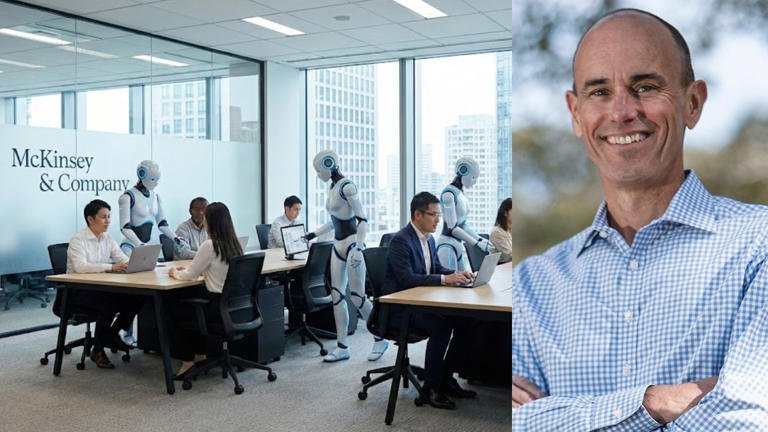
Global consulting powerhouse McKinsey & Company now counts over 60,000 “employees” — but not all are human. CEO Bob Sternfels disclosed that 25,000 of them are AI agents, working in tandem with more than 40,000 human staff. The firm’s vision is to ensure every consultant is supported by at least one AI agent to boost efficiency and productivity.
Rapid Growth of AI Agents
Speaking at CES in Las Vegas, Sternfels highlighted how McKinsey’s use of AI agents has skyrocketed from just a few thousand to nearly 25,000 in under two years. In a Harvard Business Review IdeaCast episode, he confirmed the company’s ambition: within the next 18 months, every employee will be “enabled by one or more agents.”
What AI Agents Do
Unlike basic chatbots, these agents are autonomous systems capable of breaking down problems, designing workflows, executing tasks, and delivering outputs with minimal human input. At McKinsey, they handle research, data analysis, document preparation, and client deliverables — tasks traditionally managed by junior consultants.
The “25-Squared” Model
Sternfels described the firm’s AI‑driven transformation as the “25‑squared” model: expanding client‑facing roles by 25% while reducing non‑client‑facing positions by a similar margin. AI agents have already saved 1.5 million hours in the past year, producing 2.5 million charts in six months and freeing consultants to focus on strategy, client engagement, and decision‑making.
Human Edge Still Matters
Despite the rise of AI, Sternfels emphasized that people remain irreplaceable in three critical areas: setting aspirations, exercising judgment, and fostering creativity. However, the impact on jobs is evident — McKinsey’s non‑client‑facing workforce has shrunk by about a quarter, even as productivity in those functions has increased by 10%.
Industry Implications
With 25,000 AI agents now part of its workforce, McKinsey joins global giants like Amazon in aggressively deploying AI for efficiency. While the company insists AI complements rather than replaces humans, the gradual shift of routine tasks to machine intelligence is reshaping hiring practices and the future of consulting.
Share
What's Your Reaction?
 Like
0
Like
0
 Dislike
0
Dislike
0
 Love
0
Love
0
 Funny
0
Funny
0
 Angry
0
Angry
0
 Sad
0
Sad
0
 Wow
0
Wow
0