Meet Vandi Verma: The Indian-Origin Roboticist Behind NASA’s First AI-Driven Mars Rover
NASA’s December 2025 test of AI-driven rover navigation on Mars marked a major milestone in space exploration. Indian-origin roboticist Vandi Verma led the charge, overseeing Perseverance’s autonomous drives. With AI now capable of terrain analysis and route planning, future missions to the Moon and Mars may rely heavily on intelligent systems — reducing human workload and accelerating scientific discovery.

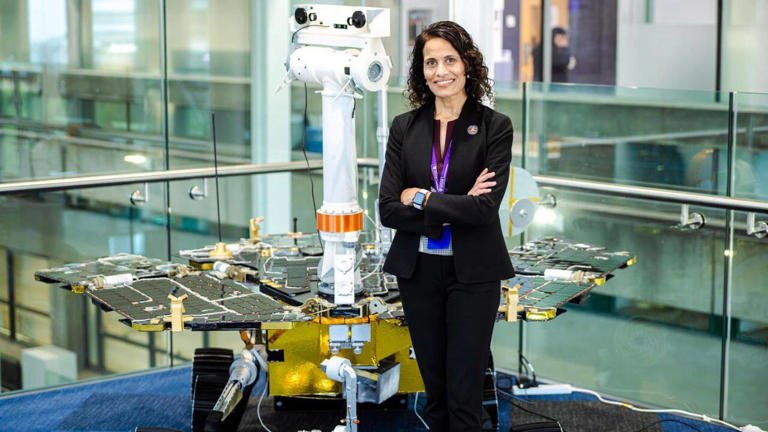
In December 2025, NASA quietly made history by testing autonomous driving on Mars — and at the heart of this breakthrough was Indian-origin roboticist Vandi Verma. On December 8 and 10, the Perseverance rover successfully completed AI-planned drives, marking the first time a Mars rover navigated terrain using artificial intelligence instead of Earth-based human commands.
A New Era in Mars Navigation
Until now, every rover movement on Mars was manually planned by teams on Earth, with commands sent across millions of kilometers. The December test proved that rovers can now independently assess terrain, identify hazards, and chart safe paths — a critical advancement as missions venture farther from Earth, where communication delays make real-time control impractical.
Vandi Verma: From India to Interplanetary Robotics
Born in India and raised in aviation circles due to her father’s service in the Indian Air Force, Verma was exposed to engineering early on. She studied electrical engineering at Punjab Engineering College, Chandigarh, before moving to the U.S. for higher studies. At Carnegie Mellon University, she earned her master’s and PhD in robotics, focusing on autonomous systems and fault diagnostics — skills that would later shape her career in planetary exploration.
Leading NASA’s Robotic Operations
Verma joined NASA’s Jet Propulsion Laboratory (JPL) in 2007 and has since worked on key Mars missions including Spirit, Opportunity, Curiosity, and now Perseverance. As Chief Engineer for Robotic Operations, she oversees rover movement, safety protocols, and autonomy testing.
During the December 2025 test, AI systems onboard Perseverance analysed terrain images, identified rocks and slopes, and generated complete driving routes with waypoints. These routes were first validated using a digital twin simulation before being transmitted to Mars — where the rover followed them successfully.
What This Means for Future Space Missions
Verma noted that AI can streamline perception, localisation, and planning tasks, reducing the burden on human operators. NASA believes autonomous systems will enable longer drives, faster exploration, and better identification of scientific targets.
NASA Administrator Jared Isaacman called the test a preview of future missions, while JPL’s Matt Wallace highlighted the role of intelligent systems across rovers, drones, and surface tech. Autonomy is expected to play a key role in upcoming Moon missions under Artemis and future human missions to Mars.
Share
What's Your Reaction?
 Like
0
Like
0
 Dislike
0
Dislike
0
 Love
0
Love
0
 Funny
0
Funny
0
 Angry
0
Angry
0
 Sad
0
Sad
0
 Wow
0
Wow
0